CROQUET BREAK
provided as a USCA member benefit.
| MOUNT DESERT ISLAND CROQUET CLUB
BOOK OF CROQUET PUZZLERS | The Mount Desert Island Croquet Club
Book of Puzzlers
by
Larry Stettner
Puzzle Master
with
The Members of the Mount Desert Island Croquet Club
Memorial Edition
Seawall Road Press Southwest Harbor, Maine 2007
This is book is dedicated to Marcia Chapman who inspired its creation and whose encouragement made it happen, and to Jack R. Osborn, who created the most strategically fascinating version of croquet ever devised.
The author acknowledges that the energy needed to actually produce this book came from his love for Alex, Andy, Ben, Big Eli, Bob, David, Eli Nadav, Emma, Francine, Janet, Jeanny, Judy, Marc, Michael, Peggy and Puccina. (I know that most of you will like the look of this book and enjoy the diagrams but will not know what the text is about at all because you do not speak the language of croquet. Amazingly enough, a few of you do speak that language. You know who you are.)
Thanks, Dad, for getting the ball rolling on this whole croquet thing so many years ago. | | Advanced Puzzler #10
Your puzzle master first saw this play when it was made by the Motown Masher himself, the legendary croquet strategist Joe Koenig. It was like a thunderbolt and has never been forgotten. The situation was this: With yellow to play very near the end of the game, blue was sitting on the S boundary behind wicket five, for four-back, and alive on all balls. Red was in the NW corner behind two, for wicket six and dead on yellow and black. Black was in front of five, for five and live only on partner blue. Yellow was on the E boundary to the side of four, for two-back and dead on partner. Yellow then made a big hit-in on black which had been sitting in front of five, driving it on the roquet towards two-back. Yellow, knowing time was running out, then did some prodigious two-balling through two-back and three-back to put its side ahead by one hoop. As yellow came through three-back it over ran black and the timer beeped indicating game time. Now yellow was first ball in last turns. Yellow tapped black for the roquet, and with nothing to lose, since it needed to get black further away from blue anyway, tried a monster roll split. It went somewhat awry and black ended up about 4 feet from the N boundary in line with penult and just a little west of center, while yellow came up very short, far away and wide of four-back. Yellow got off the court, going out of bounds in the NE corner. Now it is blue to play, second last ball. Red and yellow now have a one wicket lead. What does blue do to give its side the best chance to tie or win?
Recapping the situation facing blue as it ponders its move: Blue sits on the boundary behind five, for four-back and alive on all balls. Red is in the NW corner, for six and alive only on blue. Black is 4 feet from the N boundary, just east of the center of the court, for wicket five and alive only on blue as well. Yellow is in the NE corner, for wicket four-back and dead only on black. Time has expired and blue is second ball in last turns. | 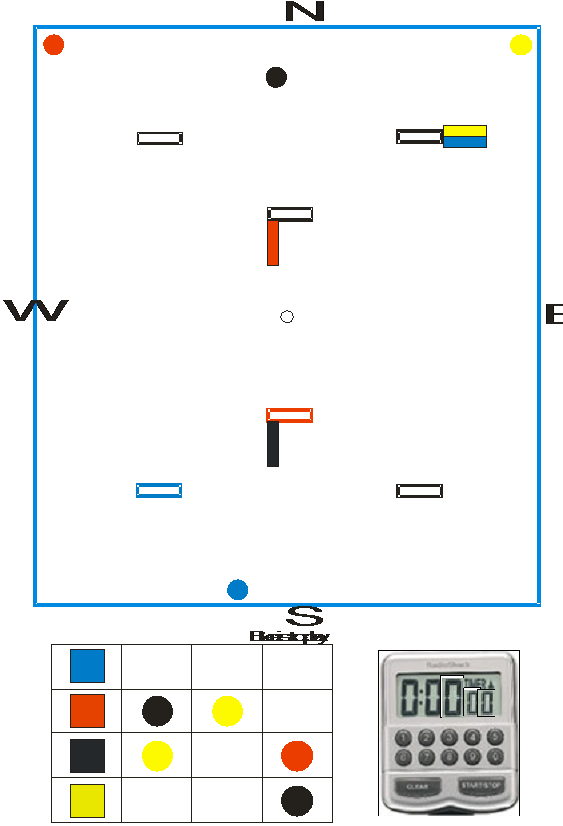 | | | Answer to Advanced Puzzler # 10
Blue should go about 3 feet southeast of wicket five in a wired position from the black ball. Because yellow is responsible for the black ball’s position, black now has a wire on a ball that is at its wicket. In essence, blue created the wire but the rules clearly state that what matters is that the opponents are responsible for the striker ball’s position, not the position of the ball or balls that the striker is wired from. Danger ball red will have little or no shot on blue, but this is not a wire, because black and blue are not responsible for red’s position. Black will now be able to take ball in hand on blue right next to its hoop, and if it gets a good split at wicket five, it can make wickets five and six for the tie and the win.
This play is far superior to blue attempting the obvious “normal” play, i.e. to set an on-the-court rush just south of black so that black could rush blue to wicket five. This is a very difficult shot from 90 or so feet away and at best leaves a long rush for black to hoop five. Further, if blue goes down near black it is getting close to red as well. If red hits blue it will take away any chance for black to make wickets. In contrast, blue just hiding from black in front of black’s hoop is an easy shot for blue and gives black the easiest of shots, in fact no shot at all to roquet blue! Black just calls the wire and becomes ball in hand on blue automatically.
Look for this play whenever you are dead on opponents and live on partner and opponents have moved you on the previous turn. It will most likely catch them by surprise and can win some games for you. Be sure there is a rule book handy when you use this play, though. (With really low handicap players this is not a problem, actually. They may not have seen it coming, but once it is done, they know that you are right, and will more than likely applaud your shrewdness rather than curse the rule makers.)
| | Advanced Puzzler # 16
A mighty battle between two championship flight doubles teams at the venerable Berkshire Invitational inspired this puzzler. It is the beginning of the fourth overtime and striker ball blue is for four-back and black is for two-back. Red is a rover and yellow is for wicket five. Blue starts off three-ball live, in the NE corner behind four-back, with a mediocre rush on black to the four-back hoop. Black is alive only on red. Red has positioned itself in the SE corner behind three-back, alive only on blue, last ball dead on black. Yellow is three-ball live and sits on the S boundary right opposite its hoop, wicket five.
Blue takes the rush, but ends up cutting black too much, and black is left about 12 feet north of four-back and about half way between the east boundary and the level of the hoop. So, blue prudently takes off, making a great shot to position, which elicits a “Yes!” from its partner, and then makes the hoop. It lands about 8 feet southwest of black. Now what is blue to do from here? Blue thinks, “Well, I have no rush, and certainly have almost no chance of splitting black successfully to penultimate if I roquet it where it is. There is no point in sending black to yellow, since black is dead on yellow. So, I guess I will just lightly roquet black, and take off for penult to try and make one more hoop. If I don’t get really good position I will bail and get off the court and just hope the opponents mess up.” When blue suggests this play to its partner, black suggests calling time out to think about it some more. They do, and they come up with a better plan. What could it be?
Summing up the situation for blue as first ball in the fourth overtime rotation: Blue is 8 feet north of four-back, is for penult and three-ball live. Red sits in the SE corner behind four-back, for the peg and alive only on blue, last ball dead on black. Black is about 4 feet north and 8 feet east of blue, in the NE corner zone, is for two-back and alive only on red. Yellow sits on the S boundary on a line with hoop five, is for five and three-ball live. What is blue, with a continuation shot, to do from here? | 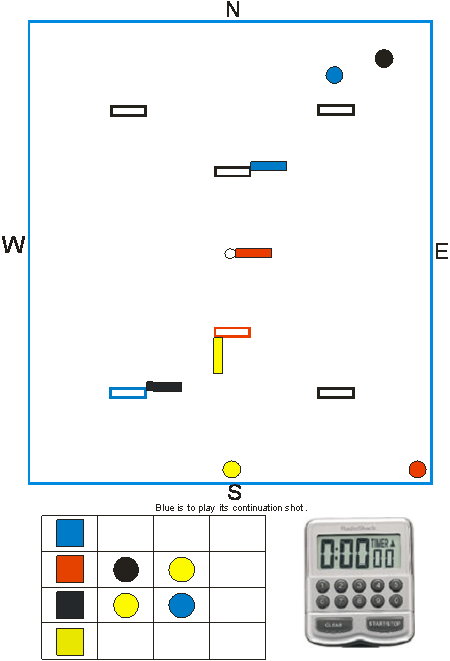 | | | Answer to Advanced Puzzler # 16
The solution is for blue to send partner black either close to spent ball yellow on the court if it can, or out of bounds just to the east side of it. Sending partner to spent ball is the right move even though, in this case, black is dead on yellow. In general, sending partner to the spent ball or vice versa can have two advantages. First, your partner can use the spent ball, and second, it keeps the danger ball opponent from successfully joining its partner. In this situation, the first does not apply but the second still does.
Black may be dead on yellow, but it is still alive on red. If blue sends black close to yellow, then black, playing before yellow, would have the opportunity to take red away if it tried to set a rush for yellow or otherwise join partner. So, red will see that setting the rush for yellow is probably pointless, unless it can put a voodoo hex on black and make it miss. Because it is on the south boundary itself, red can’t get to a point on the south boundary west of yellow where black could not hit it but yellow could. This is why blue has to get black to the east of yellow, the side that red can get to. Probably the only way red could help yellow here is to shoot to a spot near wicket five and hope that black would miss it and that yellow would hit it. Overall this leaves better odds for blue and black than blue trying a dicey wicket shot or doing anything else that would allow red to set a good rush for yellow
So, remember: there are times when it can still be useful to send partner to spent ball (or vice versa) even if partner is dead on spent ball. It just has to be alive on either the spent ball or the danger ball to prevent the join. | As you can almost see from the picture, I've had a croquet mallet in my hands most of my life.
From about 2 years old, I spent most weekends playing nine-wicket at my grandparents in New Jersey.
When I was close to retiring, my wife informed me that I needed a hobby and pointed me towards the Woodlawn Croquet Program in Ellsworth, ME. I meekly showed up with the mallet pictured above. There I learned golf croquet, and then American 6 wicket. I also met many friendly (off the court) and talented players.
At my first tournament, I met Larry Stettner, who became my mentor in croquet and far beyond. I eventually learned that he had produced a book on strategy. I asked him for a copy, but he said they were all gone. After enough pestering, Larry gave me a USB flash drive with the files on it, and I became a publisher. Now I have produced four printings of the book on my home office laser printer and have sold over 500 copies. After Larry's passing in 2017, we added a 51st puzzler in his honor. This gave me a glimpse of the amazing effort that went into the Book of Puzzlers. I believe the entire A6W community has been enhanced by this book. I'm glad to be able to keep the ball rolling. | Don Parker
207-479-5251
plc511@aol.com |
======================================================
The views and opinions expressed in the Weekly Croquet Break are those of the article authors and do not necessarily reflect the official policy or position of the United States Croquet Association (USCA)
|
Thank you for supporting the USCA!
(Registered 501(c)(3) charitable organization)
700 Florida Mango Road, 2nd Floor, West Palm Beach, FL 33406
Tel: 561.478.0760 * Fax: 561.686.5507 * www.croquetamerica.com | |